Mars
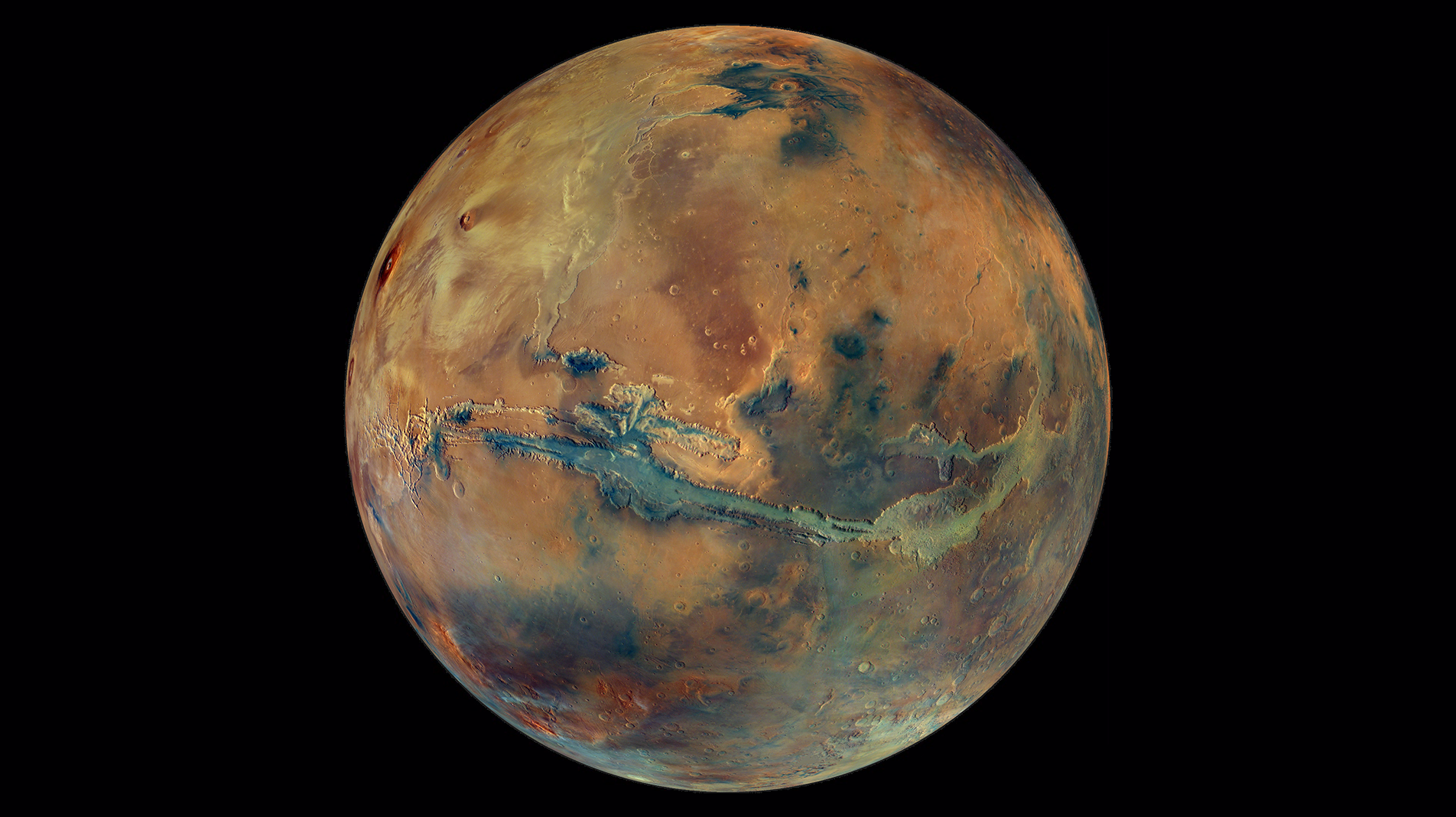
The Mars of billions of years ago was significantly different than the frigid, hyperarid planet of today. I use numerical models to study the physical processes behind the formation of river channels, lakes, and other features on the surface of Mars that may provide evidence of past climate conditions over a variety of timescales. I’m also interested in characterizing the broader geologic history of Mars, particularly in and around the massive Hellas impact basin.
Further Reading
K.R. Karpenko, J.L. Fastook, J.W. Head, A.D. Howard, C.I. Fassett, J.L. Dickson, K.E. Scanlon, B.D. Boatwright (2026). “Origin of Late Noachian-Early Hesperian Valley Networks on Mars: Insights from an Integrated Multi-Analysis Technique Approach.” JGR: Planets 131, e2025JE009478.
B.D. Boatwright and J.W. Head (2023). “Hellas Basin Witness Plate: Sequence and Timing of Altitude-Dependent Glacial Features on Early Mars.” LPSC 54, #1248.
B.D. Boatwright and J.W. Head (2023). “New Volume Estimates and Timing of Proglacial Lake Formation in a Noachian Closed-Source Drainage Basin Crater.” LPSC 54, #1162.
B.D. Boatwright and J.W. Head (2023). “Inverted fluvial channels in Terra Sabaea, Mars: Geomorphic evidence for proglacial paleolakes and widespread highlands glaciation in the Late Noachian–Early Hesperian.” Planetary and Space Science 225, 105621.
B.D. Boatwright and J.W. Head (2022). “Constraining early Mars glacial conditions from paleodischarge estimates of intracrater inverted channels.” Geophysical Research Letters 49, e2022GL101227.
B.D. Boatwright and J.W. Head (2022). “Pit-floored craters and layered terrains in the circum-Hellas region, Mars: Morphology, topography, stratigraphy, and relation to Late Noachian–Early Hesperian climate.” Planetary and Space Science 222, 105574.
B.D. Boatwright and J.W. Head (2021). “A Noachian proglacial paleolake on Mars: Fluvial activity and lake formation within a closed-source drainage basin crater and implications for early Mars climate.” The Planetary Science Journal 2, 52.
B.D. Boatwright and J.W. Head (2019). “Mars Before the Valley Networks: Outstanding Questions on Noachian Crater Degradation and Early Climate.” 9th International Conference on Mars, #6096.
B.D. Boatwright and J.W. Head (2019). “Simulating early Mars hydrology with the MARSSIM landform evolution model: New insights from an integrated system of precipitation, infiltration, and groundwater flow.” Planetary and Space Science 171, 17-33.